The Vivo S50 Pro Mini is shaping up to be a compact flagship that balances flagship-class hardware with a pocketable form factor. Tipped to arrive globally as the Vivo X300 FE, the device is scheduled to launch in China on December 15, with sales expected to begin around December 20.
At its core is Qualcomm’s Snapdragon 8 Gen 5 chipset paired with LPDDR5x RAM and UFS 4.1 storage, delivering top-tier performance in a smaller chassis. The 6.31-inch flat OLED panel offers a 1.5K resolution and a 120Hz refresh rate for sharp, fluid visuals. Software comes via Android 16 with Vivo’s OriginOS 6 on top.
Battery life is a highlight: a 6,500mAh cell supported by 90W wired fast charging and 40W wireless charging gives the phone excellent endurance and fast top-ups — a rare combination in a compact device. Complementing the hardware is an ultrasonic in-display fingerprint sensor, stereo speakers, and an X-axis linear motor for tactile feedback.
The photography setup aims for versatility. A 50MP front camera handles high-resolution selfies, while the rear array pairs a 50MP primary sensor with an 8MP ultrawide and a 50MP periscope telephoto (Sony IMX882). This arrangement should offer detailed shots, capable zoom, and flexible framing options for most shooting scenarios.
Build quality leans premium, with an aerospace-grade metal frame and IP68/69 dust and water resistance. Despite the large battery and flagship components, the phone measures approximately 150.83 x 71.76 x 8.10 mm and weighs about 192 grams, keeping it comfortable for one-handed use.
Vivo will offer multiple memory configurations to suit different needs: 12GB+256GB, 12GB+512GB, and 16GB+512GB. Colour options announced so far include Space Black, Inspirational Purple, and Confession White, giving buyers classic and more expressive finishes.
If Vivo follows its recent regional naming strategy, the S50 Pro Mini could be rebranded as the Vivo X300 FE outside China. For ongoing coverage and comparisons within the X300 family, see our Vivo coverage at passionategeekz.com/vivo-x300 and our Vivo section at passionategeekz.com/vivo. You can also browse related stories under the Vivo tag at passionategeekz.com/tag/vivo.
The December 15 event should confirm final specs, pricing, and regional availability. For readers who want a compact phone without major compromises, the Vivo S50 Pro Mini is shaping up to be one of the most interesting options this season.
The upcoming Vivo S50 has surfaced online once again, this time revealing its full set of colour options along with several major hardware details. The smartphone is confirmed to arrive in four striking finishes — Confession White, Serene Blue, Inspiration Purple, and Space Black — emphasising Vivo’s focus on premium aesthetics for the S-series lineup. This refreshed design direction continues Vivo’s trend of offering stylish and polished choices across its mid-premium catalog, similar to what we have seen on recent models covered on PassionateGeekz.
Based on the latest information available, the Vivo S50 is expected to sport a 6.59-inch flat OLED display with a 1.5K resolution and 120Hz refresh rate, delivering a smoother and more vivid viewing experience. Under the hood, the Snapdragon 8s Gen 3 is likely to power the device, paired with up to 16GB LPDDR5x RAM and up to 512GB UFS 4.1 storage, ensuring faster multitasking and improved overall performance in day-to-day use and gaming.
The battery capacity is tipped to be around 6,500mAh, though this figure is still uncertain and awaits official confirmation. However, 90W fast charging support is expected, aligning the S50 with Vivo’s recent focus on high-speed charging technology, helping users quickly top up the device. On the software side, the phone is set to run Android 16 with OriginOS 6 on top, promising optimised performance, smoother animations, and better system-level features.
For cameras, the Vivo S50 is shaping up to be quite interesting. It is said to feature a 50MP front camera for selfies and video calls, while the rear setup will house a triple camera system that includes a 50MP Sony IMX882 periscope telephoto sensor. This periscope lens should offer improved zoom performance and more detailed long-range shots compared to conventional telephoto setups, placing the S50 in a stronger position within its segment.
To support all this hardware, Vivo is reportedly using an aerospace-grade metal frame, which should add rigidity and a more premium in-hand feel. Additionally, the phone is expected to carry an IP68/69 rating, making it resistant to dust, water, and certain high-pressure environments. This combination of durability, performance, and style suggests that the Vivo S50 is being positioned as a well-rounded option for users who value both looks and reliability.
As more leaks continue to surface, launch-specific information such as pricing and availability should become clearer in the coming days. Until then, the Vivo S50 already appears to be an exciting addition to Vivo’s lineup, and it will be interesting to see how it competes against other Snapdragon 8s Gen 3 powered smartphones. For more updates on upcoming Vivo devices and other tech news, keep following PassionateGeekz.
Thank you for reading! Join our Telegram community for more tech updates and discussions: https://t.me/passionategeekz
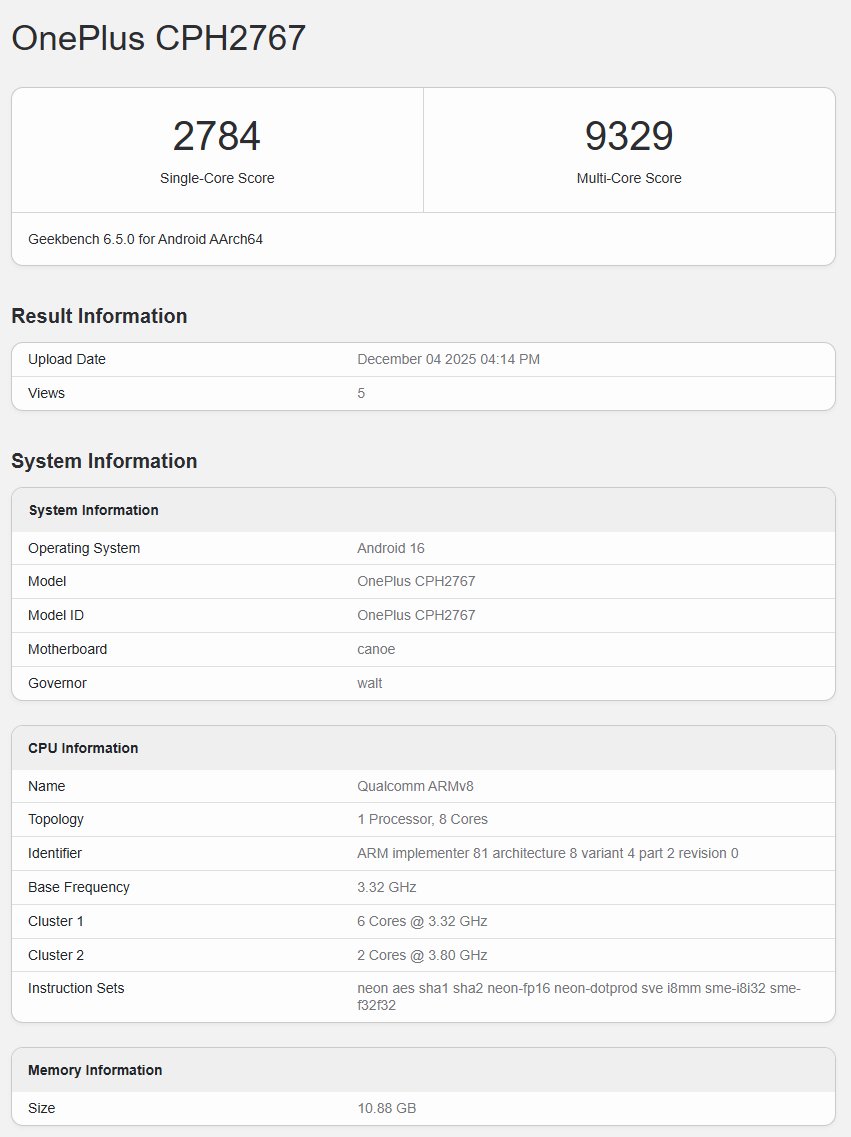
The OnePlus 15R is moving steadily closer to launch, with the device recently appearing on Geekbench under the model number CPH2767. The timing of this benchmark entry aligns with industry reports confirming that the smartphone is scheduled to debut globally on December 17, 2025. This positions the 15R as one of OnePlus’ final major releases of the year, serving as a performance-focused addition to the brand’s growing lineup.
The Geekbench listing reveals that the OnePlus 15R will be powered by Qualcomm’s next-generation Snapdragon 8 Gen 5 chipset. According to early details, the processor features six performance cores clocked at 3.32GHz alongside two high-performance cores reaching up to 3.80GHz, paired with an Adreno 829 GPU. With 12GB RAM onboard, the device is geared to deliver flagship-grade performance, making it a strong contender in its segment. The tested unit also runs Android 16, indicating OnePlus is preparing its next iteration of OxygenOS for launch.
Beyond performance, the 15R is also expected to feature a high-refresh-rate AMOLED display, improved thermals and enhanced computational photography, although full specifications will be revealed during the official event. With OnePlus confirming a December 17 launch timeline, marketing teasers and additional details are expected to roll out shortly.
The OnePlus 15R is shaping up to offer flagship power at a more accessible price point, staying true to the philosophy that has long defined the R-series. As anticipation builds, more concrete details surrounding camera configuration, battery capacity and charging speeds will surface closer to launch. For ongoing updates, insights and detailed comparisons, readers can explore latest coverage on Passionate Geekz.
Realme has expanded its wearable lineup in India with the launch of the Realme Watch 5, a feature-rich smartwatch designed for users who want a premium build, vibrant display and long-lasting endurance without stretching their budget. The smartwatch showcases a sleek metallic unibody paired with an aluminium alloy crown and a 3D-Wave strap, giving it a more refined and durable aesthetic suitable for both everyday and active lifestyles.
The Realme Watch 5 features a 1.97-inch AMOLED display with a crisp 390 × 450 resolution, 60Hz refresh rate and 600 nits peak brightness, ensuring excellent visibility indoors and outdoors. With support for over 300 customizable watch faces, users can personalise their look with ease. The watch also offers Bluetooth calling and NFC support, enhancing day-to-day convenience for quick connectivity and contactless interactions.
Fitness enthusiasts get access to 108 sports modes, guided workout programs, stretching reminders and Realme’s personal coach tools. The independent GPS module supports five GNSS systems, enabling accurate route tracking without needing a smartphone. On the health front, the Watch 5 includes continuous heart rate monitoring, SpO₂ tracking, sleep analysis, stress measurement and menstrual cycle management, providing a comprehensive wellness suite for daily insights.
Battery performance stands out as another strength. Realme claims up to 20 days of usage in light mode and around 16 days in standard mode, contributing to its practicality for long-term travel and consistent fitness tracking. Additional utility features such as music controls, a compass, breathing exercises and Game Guardian make the watch more versatile for various scenarios. The IP68 rating further ensures durability for dust and water exposure.
The Realme Watch 5 is priced at Rs 4,499, with an introductory offer discounting it to Rs 3,999. It will be available in Titanium Black, Titanium Silver, Mint Blue and Vibrant Orange. The first sale begins on December 10 at 12PM across Realme’s official site, Flipkart and mainline retail stores.
For more wearable tech updates, comparisons and buying advice, readers can explore connected device coverage on Passionate Geekz.
The Realme P4x 5G has officially arrived in India, bringing a balanced mix of performance, battery endurance and a high refresh-rate display for budget-conscious users. Positioned within Realme’s growing P-series, the device focuses on delivering reliable everyday performance powered by the MediaTek Dimensity 7400 Ultra chipset, paired with LPDDR4X RAM and UFS 3.1 storage. Users can also expand memory virtually up to 18GB, ensuring smoother multitasking across apps and games.
Up front, the Realme P4x 5G features a 6.72-inch FHD+ LCD with a fluid 144Hz refresh rate and up to 1000 nits peak brightness, making it suitable for outdoor visibility and fast-paced usage. The phone houses a 50MP OV50D40 main camera supported by a 2MP secondary sensor, while an 8MP front camera handles selfies and video calls. Running on Android 15 with Realme UI 6.0, the device includes a commitment of two OS upgrades and three years of security updates, offering users long-term reliability.
A standout aspect of the P4x is its massive 7,000mAh battery paired with 45W fast charging, positioning it as a strong contender for power users who prioritize longevity. Additional features include an in-display fingerprint sensor, stereo speakers, dual 5G support, Wi-Fi 6, Bluetooth 5.2, IR blaster and USB-C connectivity. Despite its large battery, the handset maintains a manageable 208g weight and offers IP64 protection.
Realme has priced the P4x 5G competitively, with the 6GB+128GB model starting at Rs 15,999 — effectively dropping to Rs 13,499 with launch offers. The 8GB+128GB and 8GB+256GB variants are available at Rs 14,999 and Rs 16,999 respectively under promotional pricing. Colour choices include Matte Silver, Elegant Pink and Lake Green. The first sale goes live on December 10 during a 12-hour limited window via Realme and Flipkart, with additional mainline offers available, including a Rs 2,500 bank discount on the base model.
For more smartphone comparisons, updates and buying guides, readers can explore detailed coverage on Passionate Geekz.
Xiaomi has officially introduced the Redmi 15C 5G in India, positioning it as a strong budget contender for 2026 with a design the brand calls “2026 ka Big Boss.” The device features a large 6.9-inch HD+ Dot Drop display with a smooth 120Hz refresh rate, making everyday use feel noticeably fluid. Powering the phone is MediaTek’s Dimensity 6300 5G chipset, delivering efficient performance for daily tasks and stable 5G connectivity. The device runs on HyperOS 2 based on Android 15 and comes with the promise of 2 years of software updates and 4 years of security patches, ensuring long-term reliability.
Redmi has equipped the 15C 5G with a 50MP AI rear camera and an 8MP selfie sensor, offering respectable photography performance at this price range. The phone also packs a large 6000mAh battery paired with 33W fast charging, giving users extended backup for heavy usage. Additional highlights include an IP64 rating, a 3.5mm headphone jack, and three colour options—Moonlight Blue, Dusk Purple, and Midnight Black.
As part of its value-focused approach, Xiaomi has priced the Redmi 15C 5G very competitively: ₹12,499 for the 4GB+128GB variant, ₹13,999 for the 6GB+128GB model, and ₹15,499 for the top-end 8GB+128GB configuration. The smartphone will go on sale starting 11th December 2025 via Amazon, mi.com, and Xiaomi retail stores across India.
For more updates, you can also explore related coverage on passionategeekz.com, including insights on other Xiaomi launches, Android updates, and upcoming smartphone releases.
If you enjoyed this update, join our Telegram community for more tech news and alerts: https://t.me/passionategeekz.
The Vivo X300 Pro 5G might be grabbing all the attention right now, and honestly, it’s not surprising that Zeiss-crafted camera setup and those custom telephoto kits are enough to make anyone look twice. But while the Pro model is soaking up all the hype, the standard Vivo X300 5G shouldn’t be sidelined. It still brings solid performance, great cameras, and the same premium Vivo experience, making it a strong contender in its own right.
In this review, we’re going to take a closer, honest look at the Vivo X300 5G. For anyone wondering, yes, the X300 5G does support a telephoto kit as well. It’s a smaller, compact version made specifically for this model. But the unit we received didn’t come with the telephoto kit, so this review is based entirely on the phone’s natural performance, without any telephoto shots included.
The Vivo X300 series is one of those phones that immediately feels special when you pick it up. The back has this smooth, flowing 3D glass design that feels almost sculpted, with no rough edges anywhere .it just sits comfortably in your hand. The Coral Velvet Glass finish adds a soft, velvety touch that looks premium and doesn’t get messy with fingerprints, which is honestly a relief.
And the camera bump doesn’t feel like a bump at all; it blends so cleanly into the body that it looks like a natural part of the phone. Overall, the design feels warm, refined, and really well thought out like Vivo actually cared about how the phone feels in everyday use.
The device also comes with this red back cover, and it honestly looks gorgeous. The matte red finish gives the Vivo X300 a bold yet classy feel, and it matches surprisingly well with that big circular camera setup. It really adds to the phone’s overall look and makes it stand out even more.
Dispay and and its Software
The Vivo X300 series puts a lot of thought into eye comfort, and you can feel it when you use the phone. The hardware helps reduce flicker, keeps the screen clear with Circularly Polarized Light 2.0, and even drops to 1 nit so your eyes don’t struggle in the dark. On the software side, the display adjusts brightness and colors on its own throughout the day, and you can fine-tune things to match your own comfort. There are also handy modes for gaming, scrolling, night use, and even preventing eye fatigue. Overall, it’s a screen that tries to stay easy on your eyes no matter how long you’re using it.
Absolute powerhouse in real-world performance
The vivo X300 runs on a custom-tuned Dimensity 9300+, built with vivo and MediaTek to deliver faster, smoother performance. It keeps the phone quick during heavy tasks, handles heat better, and gives a consistently snappy experience in everyday use.
Using the vivo X300 genuinely feels like handling a little powerhouse in your pocket. The moment you start running tests, it becomes obvious that this phone isn’t just about numbers it’s built to perform. The AI score shoots up so high that the app literally calls it a “monster,” and honestly, that describes the experience well. Even when you push it with stress tests, the device keeps its cool both literally and figuratively, barely heating up and holding strong performance without major drops. Hitting nearly 2 million on AnTuTu just adds another layer of confidence that this thing is tuned really well. Everything from app launches to camera processing to day-to-day multitasking feels snappy and effortless. Even the storage speeds make a difference you can feel how quickly it loads and saves things. Overall, the vivo X300 comes across as a phone that isn’t trying too hard to impress; it’s just naturally fast, smooth, and reliable in every situation.
Sound and Haptics
The vivo X300 holds up really well in sound and haptics. The speakers stay loud, clear, and consistent even when the phone is under load, so music and videos sound great. Haptics feel sharp and clean too ,every tap and swipe gets a nice, precise buzz that makes the phone feel more premium. Nothing gets mushy or weak, even during heavy performance tests. Overall, it feels polished, responsive, and surprisingly refined in everyday use. Even when the CPU and GPU are pushed during benchmarks, the vibration motor doesn’t weaken or lag, which shows how efficiently the system manages power and heat. Overall, the sound and haptic feedback on the X300 feel polished and premium
Software and Animation
OriginOS on the vivo X300 feels clean, smooth, and easy to live with. The animations are fluid, apps open quicker, and everything just feels more polished. Features like Origin Island, One-Tap Transfer, and the Office Kit make everyday tasks whether it’s sharing files or switching devices feel effortless. It’s a software experience that stays fast and intuitive without getting in your way. To know more about origin OS features and more head here
Pro Camera Setup with 5 Camera’s on board
The vivo X300 may look compact, but it packs a seriously capable camera system. Its 50MP ZEISS main camera delivers clear, natural-looking photos with true-to-life colors, while the 50MP ZEISS wide-angle portrait lens lets you capture more of the scene without losing that soft, DSLR-like portrait feel vivo is known for.
The real highlight is the ZEISS APO telephoto camera, which keeps zoom shots clean and free from color fringing, even in tricky lighting. vivo backs this up with a 2.35x Telephoto Extender, helping you zoom in closer while keeping your shots sharp and steady.
Portrait lovers get plenty to enjoy too. Modes like Multi-Focal HD Portrait, Ultra Clear Portrait, and Natural Portrait adapt to different scenes and distances, giving you studio-like results without any extra effort. Add in HDR Photo, Sports Mode, AI One-Shot, and smooth 4K 60fps Portrait Video, and the X300 makes capturing difficult moments surprisingly easy.
Overall, the vivo X300 blends a compact body with powerful ZEISS imaging tools, making it a great choice for anyone who wants pro-level photography without carrying a heavy device.
The Vivo X300 5G feels like one of those phones that quietly wins you over. It doesn’t scream for attention like the Pro model, but the more time you spend with it, the more you realize how solid and well-balanced it really is. The design feels warm and premium in the hand, the display is genuinely comfortable for long use, and the performance holds up no matter what you’re doing gaming, scrolling, shooting photos, or just living on social apps all day.
Even without the telephoto kit, the camera system shows its strength. Photos come out clean, natural, and reliably good, and the extra ZEISS touches really make a difference. Add to that the surprisingly good speakers, sharp haptics, smooth OriginOS animations, and you get a phone that feels polished in all the right ways.
At the end of the day, the vivo X300 5G isn’t trying to be flashy. It’s just a phone that gets things right comfort, performance, cameras, and everyday usability. If you want a flagship experience without going overboard on price or size, this one fits perfectly.
Samsung has finally taken the wraps off the Galaxy Z Trifold, introducing a bold new form factor that pushes foldable design to the next level. The device comes powered by the Snapdragon 8 Elite for Galaxy, ensuring top-tier performance for multitasking, media and productivity across its expansive tri-fold display.
The standout feature of the Galaxy Z Trifold is its large 10-inch fully unfolded screen with a 2160 × 1584 resolution and a smooth 120Hz refresh rate, delivering a tablet-like canvas in a compact folding body. When folded, it offers a 6.5-inch 2520 × 1080 cover display, also running at 120Hz, ensuring a seamless experience in both phone and tablet modes.
Samsung has equipped the Galaxy Z Trifold with a capable camera setup, led by a 200MP primary sensor, followed by a 12MP ultrawide camera and a 10MP 3x telephoto lens. This makes the device one of the most advanced foldables in terms of imaging capability, balancing both versatility and high-resolution photography.
The build quality also stands out with a titanium hinge and aluminum frame, and the device carries an IP48 rating for dust and splash protection. Impressively, the Galaxy Z Trifold measures just 3.9mm when fully unfolded, showcasing Samsung’s engineering refinement in creating slim, flexible hardware.
To power this ambitious design, Samsung has included a combined 5600mAh battery, giving the device enough endurance for extended usage across its multi-display layout. Paired with the efficiency of Snapdragon’s newest flagship chipset, the Galaxy Z Trifold is positioned as a powerful new option for users looking to replace both their smartphone and tablet with a single, flexible device.
For more updates, detailed breakdowns and comparisons, you can continue exploring similar stories on PassionateGeekz. Thank you for reading! For more tech insights and community discussions, join our Telegram channel: https://t.me/passionategeekz
Poco is getting ready to bring the Poco C85 5G to India, following the launch of its 4G variant in the Philippines earlier this year. The company has shared a short teaser on X, offering a brief look at the upcoming device, and a dedicated microsite is now live on Flipkart, confirming that the smartphone will be available on the platform once it launches.
The Flipkart microsite gives a partial view of the camera island, showcasing a circular module with rounded edges similar to the Poco C85 4G. It also confirms that the device will feature a dual-camera setup with a circular LED flash, and the text inside the camera ring highlights a 50MP AI Camera. Apart from this, the microsite doesn’t reveal much, but the design closely aligns with its 4G sibling.
According to rumours, the Poco C85 5G is expected to debut as a rebranded Redmi 15C 5G. This speculation became stronger when the device appeared on the Google Play Console, showing a Dimensity 6300 chipset and a model number that closely matches the Redmi 15C 5G. While this strengthens the rebranding theory, some confusion remains regarding its software version.
The Google Play Console listing indicated that the Poco C85 5G was running Android 16 Beta. However, the Redmi 15C 5G launched with Android 15, and its Indian microsite confirms it ships with Android 15 backed by HyperOS 2. This raises questions about whether Poco plans to launch the C85 5G with Android 15 or Android 16 in India. For now, there is no official confirmation.
With the Flipkart microsite now active and teasers rolling out, more details about the Poco C85 5G should surface in the coming days. Its expected rebranding, solid design familiarity, and Dimensity-powered 5G hardware suggest that Poco is preparing another strong budget contender for the Indian market.
For more updates, comparisons and detailed coverage on upcoming smartphone launches, explore additional stories on PassionateGeekz. Thank you for reading! Join our Telegram community for the latest tech news: https://t.me/passionategeekz
The Vivo X300 Pro has officially launched in India, bringing a premium flagship experience with a strong focus on display quality, camera performance and long-term durability. Powered by the MediaTek Dimensity 9500 chipset, the device pairs LPDDR5x RAM with quad-channel UFS 4.1 storage and an Ice Pulse Fluid VC cooling system, ensuring consistently smooth and reliable performance for demanding workloads.
The smartphone features a 6.78-inch flat BOE Q10+ OLED panel with a sharp 2800×1260 resolution and an 8T LTPO layer that shifts between 1Hz and 120Hz for power efficiency. With 4500 nits peak brightness, 2160Hz PWM dimming, DC-like full brightness dimming and Circular Polarization 2.0, the X300 Pro delivers a visually striking and comfortable viewing experience suitable for outdoor use and extended reading sessions.
Photography is the Vivo X300 Pro’s key highlight. The rear camera setup includes a 50MP Sony LYT-828 primary sensor with OIS, a 50MP Samsung JN1 ultra-wide lens, and a powerful 200MP Samsung HPB periscope telephoto camera with OIS for lossless zoom and detailed long-range shots. The imaging system is enhanced by the VS1 pre-processing chip paired with the V3+ post-processing chip, ensuring improved clarity, noise control and color accuracy. On the front, a 50MP Samsung S5KJN1 sensor with autofocus ensures sharp selfies and stable video calling.
A large 6,510mAh battery powers the device, supported by 90W wired and 40W wireless charging. This combination aims to offer long endurance while keeping charging times efficient. In addition, the Vivo X300 Pro includes an ultrasonic in-display fingerprint scanner, dual speakers, and a refined X-axis linear motor (751440 model) that enhances haptics in games and UI interactions.
Connectivity is equally robust with Wi-Fi 7, Bluetooth 5.4, NFC, an IR blaster, USB 3.2 Gen 1 and Vivo’s Universal Signal Amplification System 3.0, which uses a 1+4 chip design to maintain strong wireless performance. The device weighs 226 grams and measures 161.98 × 75.48 × 7.99mm, featuring IP68/69 certification for resistance against dust, splashes and high-pressure water.
In India, the Vivo X300 Pro is priced at ₹1,09,999 for the sole 16GB+512GB configuration. It is available in two premium finishes: Elite Black and Dune Brown. Vivo is also offering the Zeiss Telephoto Extender Kit at ₹18,999 for photography enthusiasts seeking added versatility. Pre-bookings start today, with open sales scheduled from December 10 across Vivo India, Flipkart, Amazon and major offline retail stores.
To explore more tech news, reviews, comparisons and product launches, you can visit PassionateGeekz for deeper insights and helpful guides. Thank you for reading! For more updates, insights and community discussions, join our Telegram channel: https://t.me/passionategeekz